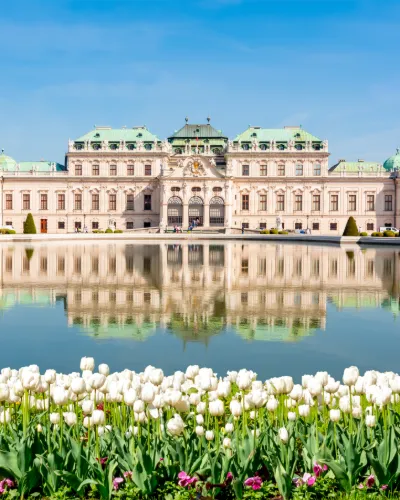
Austria is a country that combines culture, history and quite impressive nature in one place. Here you can find everything from vibrant big cities to dramatic mountains and small cozy villages, so it almost doesn't matter what you're looking for, you'll always find something that suits you. You might wonder if that mix isn't the country's strongest card. One day you might be strolling the elegant streets of Vienna, the next day you're focusing on Mozart and culture in Salzburg. There are plenty of options for different tastes. With our trips to Austria, you get accommodation, destinations with well-thought-out programs and really talented tour guides, so you can both avoid hassle and get the most out of your time.
Capital
★ Vienna
Language
★ German
Residents
★ Approximately 9.1 million
Currency
★ Euro (€)
There is plenty to see and do in Austria, especially if you like history, culture or just beautiful landscapes. In Vienna, you almost stumble upon famous buildings such as Schönbrunn Palace or St. Stephen's Cathedral. Salzburg has something special about it with its old town center and the Hohensalzburg Fortress that rises up on the mountain. Outside the larger cities, nature really spreads out. The Alpine landscape, with peaks and green valleys, is basically an attraction in itself. You will find small lakes here and there, and in the summer it becomes popular to hike. Lake Constance is located in the western part of the country and is well known for its excursion destinations and cozy villages.
Vienna is the capital of Austria and about two million people live here. Vienna is located in the eastern part of the country, right on the Danube River. It is hard to miss how Vienna has long been a bit of a center for culture, politics and music in Europe. When talking about sights in Vienna, names like Schönbrunn Palace, St. Stephen's Cathedral and of course the famous Vienna State Opera often come to mind quite quickly. They are all typical stops for those who want to see the city's most famous places. Something you should not forget when you are there: the city's classic café culture. Sitting down in a café and perhaps trying a piece of Sachertorte or having a Wienerschnitzel is part of the experience on a trip to Vienna. There are also plenty of museums, restaurants and shopping to choose from.
Austria is perhaps a bit of an obvious choice for anyone considering a skiing holiday in Europe. The country's Alps spread over large areas and it is actually difficult not to be impressed, especially if you like snow and mountains. The ski resorts here are usually quite well equipped with modern lift systems, and there are plenty of both easier and more advanced slopes. Regardless of whether you are a beginner or have been skiing for several years, you can usually find something to suit your level. But the Alps do not only offer skiing, the winter landscapes here are something special, with charming small villages and often really cozy restaurants scattered among the slopes. And if you want to rest your legs for a day, there is always something else to do, the range of activities is quite wide, if I may say so.
Salzburg is one of the most well-known cities in Austria and many people immediately think of Mozart when the name comes to mind because he was born here. The streets are often narrow and lined with baroque buildings, which gives the whole city a special character when you stroll around, and there are of course several classic sights, such as the Hohensalzburg Fortress. For those who like music, there is a lot to enjoy; Salzburg is actually just as famous for its music festivals, where classical music has a special place. In other words, it is a city that works for both those who want cultural experiences and those who prefer to get out into nature. Perhaps it is even this combination that makes trips to Salzburg a little extra special.
Lake Constance is one of the largest lakes in Central Europe. The area is also easy to explore with its walking paths, cycling trails and boat trips. The island of Mainau is one of the most famous places on the lake and it is known for its gardens and parks. For those who prefer nature-oriented and excursion-driven trips, Lake Constance is an alternative.
When traveling to Austria, especially if the destination is the Alps, it is often extra important to think about what you actually pack in your bag as the weather changes quite quickly there. Be sure to wear comfortable shoes, especially if you are walking around the cities or if you are going out on one of the many trails in the mountains. During periods when the pressure is a bit higher, such as in summer or during the ski season, it is usually wise to book certain popular activities before you travel. With a little forethought and proper planning, the visit is usually both easy and quite eventful.
The climate in Austria is varied and influenced by landscapes with high mountain ranges, valleys and plains. Austria, which is located in the central parts of Europe, has a temperate climate with distinct seasons. In the western parts of Austria it is an alpine climate, cold winters with snow and cool summers. The eastern parts of Austria, such as Vienna, have a more continental climate with warm summers and cold winters. In the south of Austria there is a milder climate that can sometimes be reminiscent of a Mediterranean climate with warm summers and pleasant autumns. The Alps mountain range acts as a weather barrier and is one of the reasons why the climate in the north and south can differ.
In the Alpine parts of Austria, winters bring a lot of snow and cold temperatures. Summers in the Alps are cool and temperatures are pleasant, but the weather can change quickly and thunderstorms are common during the summer months. In Vienna, it is usually sunny during the summers and during the winter it can be cold with snow and frost. During both autumn and spring in Austria, the weather is generally mild with pleasant temperatures, but also weather that can change.
The Foehn wind
★ Föhn is a warm, dry wind that occurs when air masses are forced over the Alps and heated on their way down to the valleys. The wind can raise temperatures by up to 20 degrees in just a few hours.
Grossglockner
★ Austria's highest mountain, the Grossglockner, reaches 3,798 meters and is covered in glaciers and snow year-round. The mountain and its glaciers influence the climate and serve as a source of water for large parts of the country.
We use our own cookies and third-party cookies so we can display the website to you and better understand how you use it, allowing us to improve the services we offer.